Real Situations. High Stakes. Measurable Change.


Uniform execution playbooks fail because every organization's strategy and culture is different. When the two drift apart, the symptoms look familiar — disengagement, missed deadlines, rising cost — but the root cause is usually hidden in structure, trust, and alignment. Here's what happened when we made it visible.
Change doesn't fail for lack of strategy.
It fails because people resist what they don't trust.
The Board Became the Operating Committee
an educational non-profit at scale
The buyer's question: "Our volunteers are disengaging and nothing moves — is this a people problem or a system problem?"
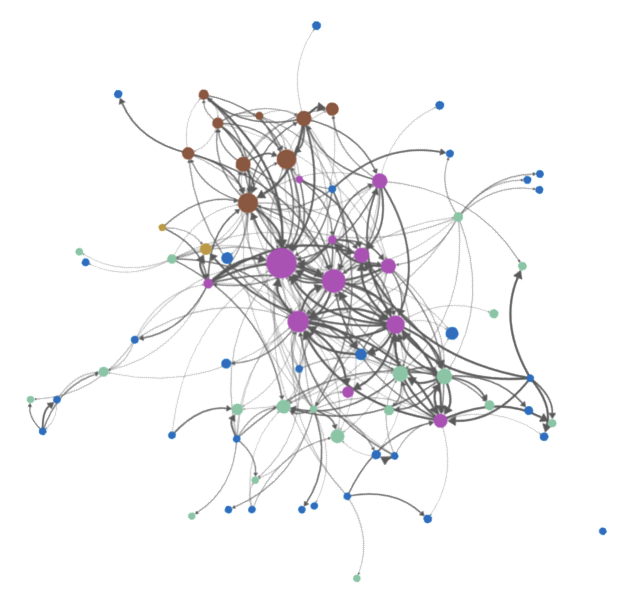
A 5,000-volunteer educational nonprofit was stuck: volunteers disengaging, accountability slipping, a post-COVID world it couldn't pivot to. The assumption in the room was that passion had faded. We ran an independent network analysis across its leadership — board, executives, regional and chapter directors — to find out what was actually true.
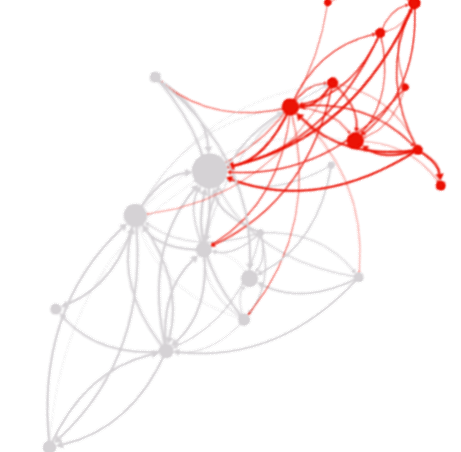
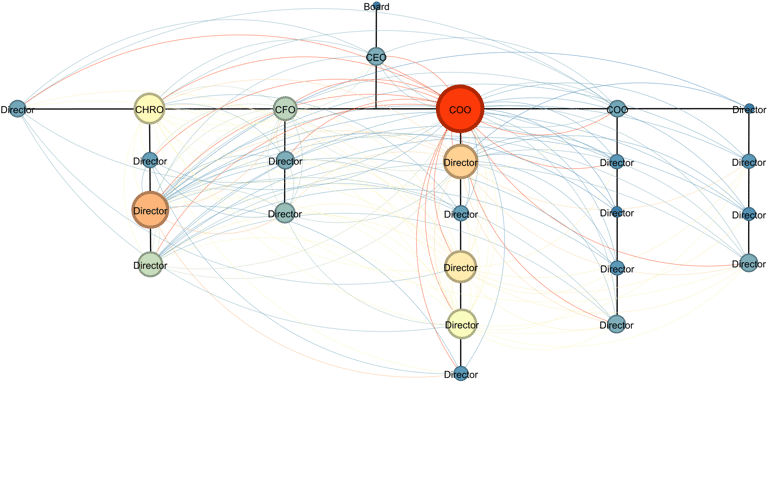
What a healthy board–executive relationship looks like: focused communication (mostly through the CEO) paired with broad, strong trust. What we found was the inverse: broad, thin communication with trust concentrated in a handful of individuals. The practical effect — a board operating like an executive committee, a management team unable to become effective, and an organization clinging to legacy processes it already knew it needed to leave behind. The cost was human, and people said so plainly. One volunteer: "I have 300, 400 hours to give. But if I keep hitting brick walls, I'll give that time to another organization."
The disengagement wasn't a passion problem. It was structural — a predictable response to growth the operating model had outgrown. The analysis let the organization act on fact instead of speculation, and we helped design a path forward that used its existing, trusted power brokers to extend credibility outward — regenerating trust and competence across the system rather than relying on a few overloaded individuals.
"Our people are disengaging and the HR programs aren't working. What are we missing?"
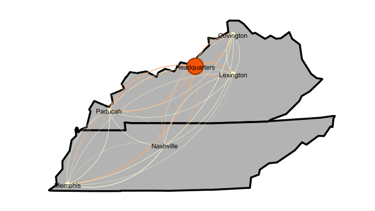
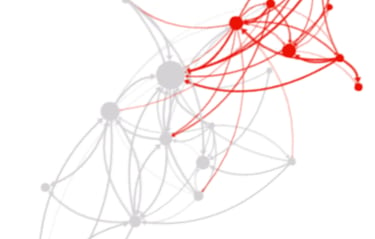
Engagement was falling and collaboration weakening despite targeted HR programs, with accountability slipping alongside. The assumption was a motivation problem. The analysis found the opposite: critical information and decision guidance had no pathway into the wider organization — the informal network had gaps the org chart hid. We strengthened the communication structure, realigned incentives, and routed alignment through the trusted people already embedded in the network. Decision-making sped up materially by 30%.
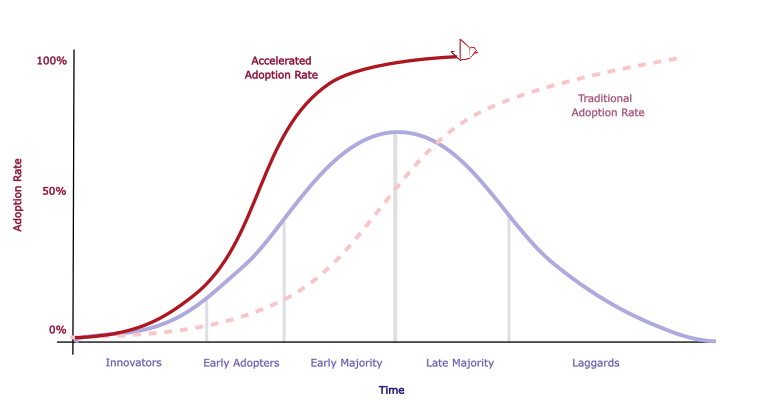
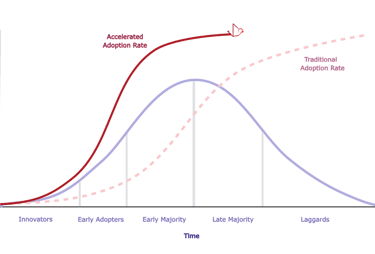
The principle: change travels along trust networks faster than through formal mandates — but only where the pathways exist (Rogers, Diffusion of Innovations).
Faster Decision-Making
mid-market healthcare
Removing Speculation
educational non-profit
"Our volunteers are disengaging and we can't pivot. Is the passion gone or is it something else?"
Volunteers were pulling back, accountability was slipping, and the organization couldn't move in a changed, post-COVID world — even though it knew it needed to. The board assumed passion had faded. An independent network analysis across its leadership — board, executives, regional and chapter directors — found something else: a board operating like an executive committee, with a management team that couldn't take hold beneath it. The disengagement wasn't a people problem; it was structural — a predictable response to growth the operating model had outgrown. With the real picture in hand, the organization could act on fact instead of speculation, and we designed a path forward that used its existing, trusted power brokers to extend credibility outward — regenerating trust and competence across the system instead of leaning on a few overloaded individuals.
The principle: a healthy leadership network shows focused communication and broad trust. The inverse — broad communication with trust concentrated in a few — usually means the board has drifted into operating, and the team can't lead.
30 Months, not 10 Years
national financial services
Strengthening Succession
PE backed operator
"Why is this transformation scoped to take a decade?"
A major digital transformation was scoped at five to ten years — and every year it ran compounded cost, execution risk, and people risk. The analysis showed that structural misalignment, not effort, was throttling progress; realigning the structure let the system absorb change at scale. It was completed in roughly 30 months instead of the estimated decade, saving more than $10M in fees, lost productivity, and consulting spend.
The principle: sequenced through the right network, change crosses the adoption threshold where momentum becomes self-sustaining (Centola, complex contagion — the ~25% tipping point).
"Our new leader can't get traction and the team won't rally. Did we hire wrong?"
A successor — often an outside hire — was struggling to gain traction, and teams hesitated to rally behind new leadership. The analysis reframed it: this wasn't a talent problem. Unclear authority and missing trust pathways had left the new leader unsupported. We clarified decision rights, mapped the influence network, and deliberately reinforced trust in the successor, replacing boardroom speculation with evidence.
The principle: successions hold or break on trust and authority established early, not on the résumé.
"Navigating CEO succession was our Board's most critical decision. 3Fold's ONA-backed approach revealed insights not visible on any chart--showing how trust and credibility influence decisions. Their approach replaced boardroom speculation with confidence."
Jody R., President
Confidential, PE-backed Operator
★★★★★
"We faced a classic strategy-to-execution gap--brilliant on paper, but stalled in reality. The multi-disciplinary approach bridged that and drove the initiative from within. The result? Implementation several months ahead of schedule, accelerating our speed to market and limiting employee fatigue."
Joe Mills,. Sr. Director
CapitalOne Financial
★★★★★
Leave stronger than you started!
A successful engagement should do more than solve today's problem. You should understanding the organization better. Teams should be equipped to run the change. And the organization should be capable of solving the next problem without us.
Subscribe to Our Newsletter